Why We Built on Base
Every technical decision at Numex starts with one question: does this make the collector experience better?
When we chose to build our onchain infrastructure on Base - Coinbase's Layer 2 network built on the OP Stack - it wasn't because we wanted to be a "crypto company." It was because Base gave us the best combination of low cost, institutional credibility, and mature tooling for what we actually put onchain.
Here's why that matters, and what it means for collectors.
What We Actually Put Onchain
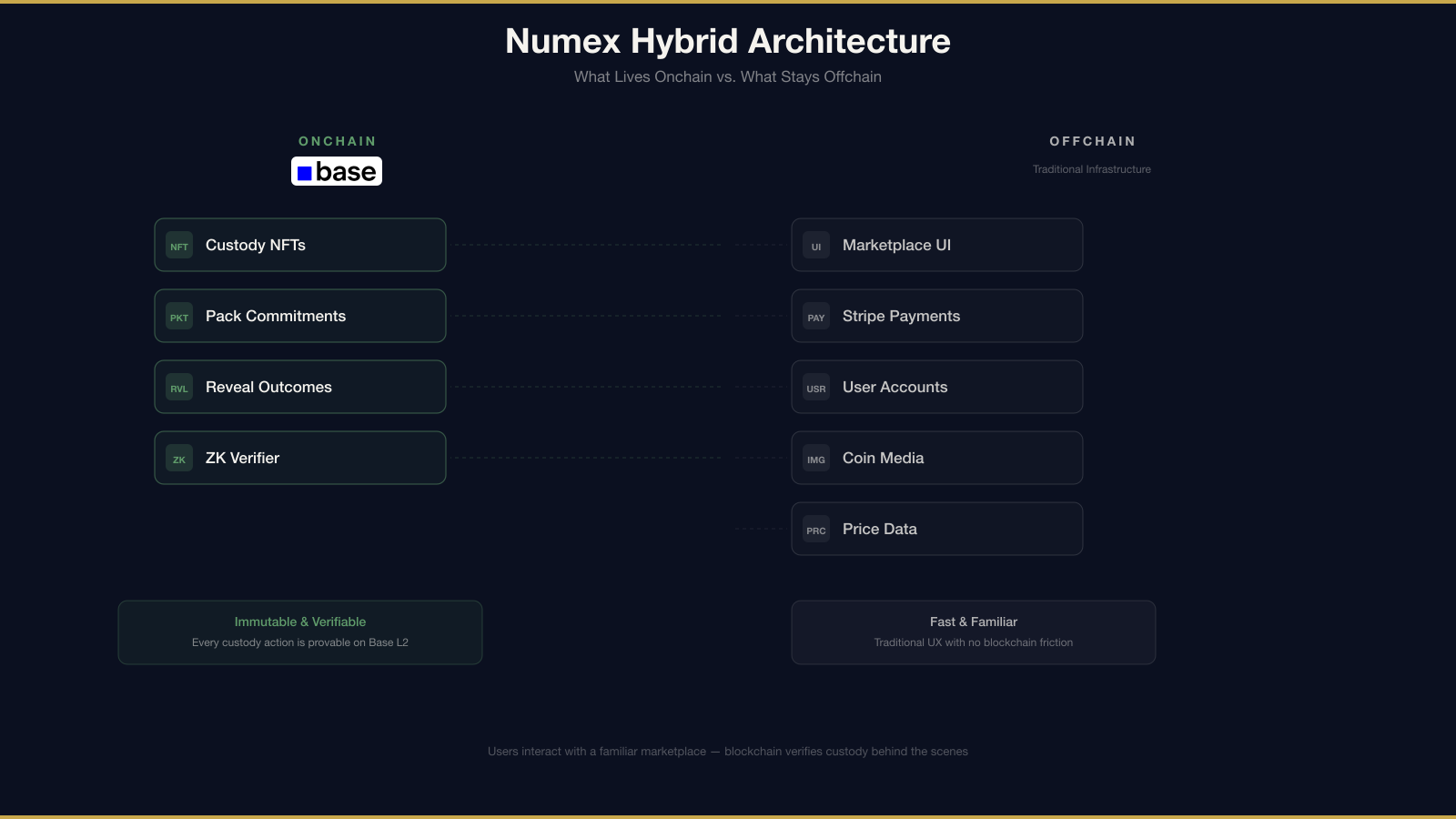
Most of Numex lives offchain. The marketplace, payments (Stripe), user accounts, coin media, pricing data, and the entire collector experience run on conventional web infrastructure - Supabase, Vercel, and standard APIs.
What goes onchain is narrow and intentional:
- Custody NFTs - Each vaulted coin is represented by an ERC-721 token on the Numex Registry. This token is the onchain proof that a specific physical coin is held in vault custody and who owns the claim to it.
- Pack commitments - Before a mystery pack goes on sale, we commit a cryptographic hash of the pack pool to the chain. This locks the contents and odds before any buyer can purchase, making the reveal provably fair.
- Reveal outcomes - After a pack is opened, the reveal result (which coin was selected and the Merkle inclusion proof) is recorded onchain. Anyone can verify the outcome matched the committed pool.
- ZK ownership verifier - An UltraPlonk verifier contract that enables zero-knowledge ownership proofs. A collector can prove they own an asset in the registry without revealing which one.
Everything else stays offchain, where it belongs. Blockchain is our audit trail and trust layer - not our application platform.
Why Layer 2 Over Layer 1
Minting a custody NFT on Ethereum mainnet (Layer 1) costs $5–50+ in gas fees depending on network congestion. When you're minting tokens for coins that sell for $50–$500, that gas cost is a dealbreaker.
Layer 2 networks like Base process transactions on a separate chain and periodically settle proofs back to Ethereum mainnet, inheriting its security guarantees. The result: transaction costs drop to fractions of a cent while maintaining Ethereum-grade security.
For Numex, where we mint custody tokens, record pack commitments, and anchor reveal proofs for every transaction, L2 economics aren't optional - they're a prerequisite.
Why Base Specifically
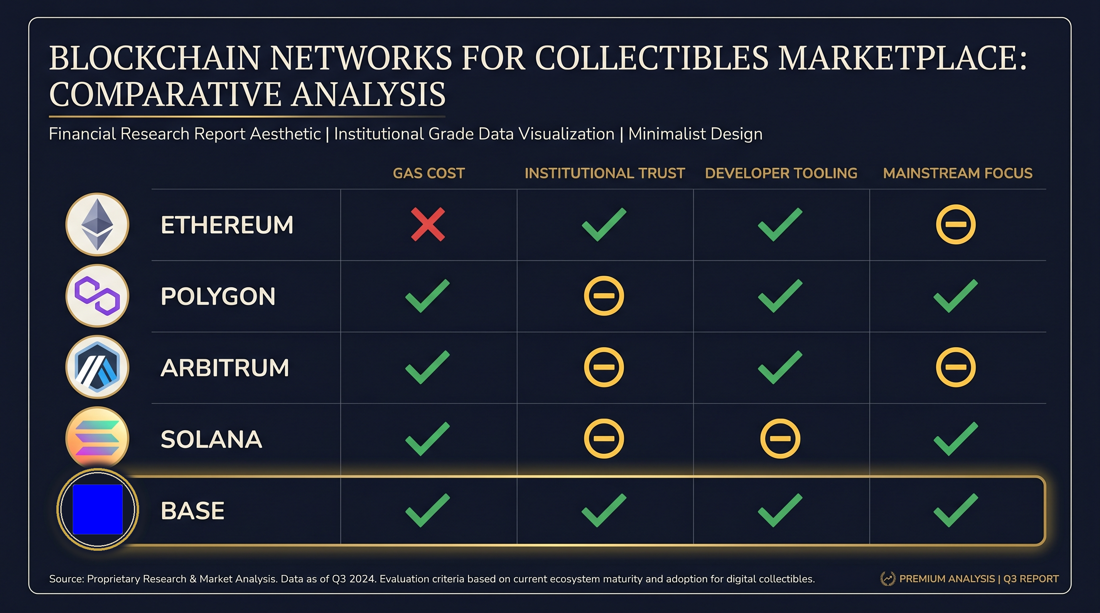
We evaluated Base, Polygon, Arbitrum, Optimism, and Solana. Here's why Base won.
Coinbase ecosystem and institutional credibility. Numex is building for collectors and investors, not DeFi traders. Base is operated by Coinbase - a publicly traded, regulated company (NASDAQ: COIN). When an investor or institutional partner asks "what chain are you on?", the answer "Coinbase's chain" carries weight that matters in traditional finance and collectibles markets.
OP Stack maturity. Base is built on the OP Stack, the same open-source framework that powers Optimism. The OP Stack has been battle-tested across billions of dollars in transaction volume, has a clear upgrade path, and benefits from the combined engineering of the Optimism Collective and Coinbase.
Bridge infrastructure. Moving assets between Ethereum mainnet and Base is straightforward through Coinbase's native bridge and third-party bridges. For a platform that may eventually support cross-chain ownership verification, robust bridge infrastructure matters.
Developer tooling. Base is fully EVM-compatible, which means standard Solidity development, Hardhat/Foundry testing, and all existing Ethereum tooling works without modification. Our contracts - the NumexRegistryV2, the PackCommitmentRegistryV2, the UltraPlonk verifier - were developed and audited using the same tools the Ethereum ecosystem has refined for years.
Mainstream adoption alignment. Base is designed for bringing the next billion users onchain, not for maximizing DeFi yield. That philosophy aligns with Numex: we want collectors to benefit from blockchain infrastructure without needing to understand it.
Why Most Users Will Never Know
If we've done our job right, you'll never think about blockchain while using Numex.
You browse coins. You buy a pack. You open a reveal. You see your coin in your portfolio. You redeem it or sell it. At no point do you need a wallet, gas tokens, or chain knowledge.
Behind the scenes, your custody NFT was minted, your pack reveal was anchored, and your ownership is provably recorded on Base. But the experience feels like any premium marketplace - because that's what it is.
Blockchain is plumbing, not a feature. We use it because it makes the system more trustworthy, not because it makes a good marketing story.
Live on Base Mainnet
Our contracts are deployed and verified on Base mainnet:
| Contract | Basescan |
|---|---|
| NumexRegistryV2 | 0x559e...67E2 |
| PackCommitmentRegistryV2 | 0x4B05...464e |
| UltraVerifier (ZK) | 0x818c...3a1A |
| OwnershipVerifier | 0xc59c...374a |
Every contract has been through a simulated four-auditor security review (Sherlock, Cyfrin, ConsenSys Diligence, Trail of Bits) with all critical and high findings resolved before mainnet deployment. The registry includes reentrancy guards, admin renounce protection, custody state machine enforcement, and nullifier tracking for ZK proofs.
The Honest Tradeoff
No chain choice is perfect. Base is younger than Polygon and Arbitrum. Its ecosystem is smaller. Coinbase's operational control means it's more centralized than a fully decentralized L1.
We made this tradeoff deliberately. For a platform where the primary users are coin collectors - not crypto natives - institutional credibility, low costs, and mainstream alignment matter more than maximum decentralization. As the OP Stack matures and Base's sequencer decentralizes further, these tradeoffs narrow.
The goal was never to pick the "best blockchain." It was to pick the right infrastructure for building a trustworthy collectibles marketplace. Base is that infrastructure.